For many companies, growth rarely arrives in a straight line.
One quarter, business is booming and teams are stretched thin. The next, hiring slows while leaders wait to see what the market does next. New opportunities appear quickly. Timelines tighten. Budgets shift. Priorities evolve.

In today’s business environment, flexibility is not just helpful. It is a competitive advantage.
That is one reason more organizations are turning to contract staffing as part of a smarter growth strategy.
For CEOs, CFOs, HR leaders, and hiring managers, contract staffing is no longer viewed as simply a short-term fix. It has become a strategic way to build momentum, manage uncertainty, access specialized talent, and keep business moving forward without overextending internal teams.
The companies growing the fastest are often not the ones hiring the most aggressively. They are the ones hiring the most strategically.
Contract Staffing Helps Companies Move Faster
Growth creates pressure.
Sometimes that pressure comes from opportunity:
- A new client lands unexpectedly
- A project timeline accelerates
- A department takes on more work than anticipated
- A company expands into a new market
- A technology rollout requires specialized expertise
Other times, the pressure comes from disruption:
- Employee turnover
- Hiring freezes
- Budget uncertainty
- Long recruitment cycles
- Seasonal workload spikes
In either scenario, waiting months to hire full-time employees can slow progress considerably.
That is where contract staffing can help.
Instead of placing critical work on hold while searching for permanent hires, companies can quickly bring in experienced professionals who are ready to contribute immediately. This allows organizations to maintain momentum while remaining flexible about long-term staffing decisions.
For leadership teams, speed matters.

Projects move forward. Teams avoid burnout. Clients remain supported. Revenue opportunities are protected.
In many cases, contract staffing allows organizations to solve business problems now instead of waiting for “perfect timing” that may never arrive.
Flexibility Matters in Unpredictable Hiring Conditions
Many employers are navigating a hiring market that feels difficult to predict.
Some industries are seeing cautious hiring activity. Others are growing rapidly but struggling to find qualified talent. Even organizations with strong long-term outlooks may hesitate to add permanent headcount too quickly.
Contract staffing creates flexibility during these uncertain periods.
Rather than committing immediately to a permanent hire, companies can scale teams up or down based on current business needs. This gives leadership more room to adapt without sacrificing productivity.
For CFOs especially, this can create more confidence around workforce planning.
Contract staffing allows businesses to:
- Respond to changing workloads
- Support short-term initiatives
- Fill skill gaps quickly
- Reduce hiring risk
- Manage labor costs more strategically
- Maintain operational continuity during transitions
That flexibility can be especially valuable during mergers, system implementations, rapid growth periods, or organizational restructuring.
The reality is that business rarely pauses while companies search for talent.
Work still needs to get done.
Specialized Talent Without Long Hiring Timelines
Many organizations today are looking for highly specific skill sets.
Finance and accounting teams may need temporary support during audits, ERP implementations, or year-end reporting. HR departments may require additional recruiting or onboarding help during hiring surges. Operations teams may need project-based leadership support.
Finding the right full-time candidate for these roles can take significant time.
Contract staffing provides access to experienced professionals who can step into specialized roles quickly and start contributing with minimal ramp-up time.
This is particularly valuable for companies that:
- Need expertise for a defined period
- Do not require a permanent role long term
- Want to evaluate future staffing needs before committing
- Need immediate support during high-demand periods
Strong contract professionals are often highly adaptable, experienced in fast-paced environments, and comfortable integrating into new teams quickly.
And contrary to outdated assumptions, many highly skilled professionals actively seek contract jobs because they value flexibility, project variety, and the opportunity to work across multiple industries.
The contract talent market today includes experienced professionals across finance, HR, operations, administration, technology, healthcare, and executive support roles.
Contract Staffing Can Reduce Burnout Across Teams
One of the hidden costs of understaffing is team fatigue.
When organizations delay hiring for too long, existing employees often absorb the additional workload. Over time, that pressure can impact morale, productivity, retention, and even company culture.

High-performing employees are incredibly valuable. But even great teams have limits.
Contract staffing can help relieve pressure before burnout becomes a larger organizational issue.
By bringing in temporary or project-based support, companies can:
- Stabilize workloads
- Protect employee wellbeing
- Improve productivity
- Reduce overtime strain
- Allow leaders to focus on strategic priorities instead of constant firefighting
Sometimes the biggest value of contract staffing is not just the work being completed. It is the breathing room it creates for the rest of the organization.
Contract-to-Hire Creates a Strategic Hiring Advantage
Another reason companies increasingly rely on contract staffing is the ability to evaluate fit before making a long-term hiring decision.
A resume and interview only tell part of the story.
Contract-to-hire arrangements allow employers to see how someone performs within the actual business environment before extending a permanent offer.
This approach can help reduce costly hiring mistakes while increasing confidence in long-term hiring decisions.
For hiring managers, this creates an opportunity to evaluate:
- Technical skills
- Communication style
- Adaptability
- Team fit
- Leadership potential
- Work ethic
At the same time, candidates can evaluate whether the organization feels like the right fit for them as well.
In many cases, contract staffing creates stronger long-term placements because both sides have already experienced working together successfully.
The Strongest Growth Strategies Prioritize Agility
The companies that continue growing during uncertain markets are often the ones willing to stay agile.
That does not mean avoiding permanent hiring altogether. Long-term employees remain essential to culture, leadership continuity, and organizational stability.
But smart growth often requires a workforce strategy that includes flexibility alongside permanence.

Contract staffing allows organizations to:
- Move faster
- Respond strategically to change
- Access specialized expertise
- Reduce operational strain
- Support growth without overcommitting resources
In other words, it helps companies go further without forcing them to take unnecessary risks.
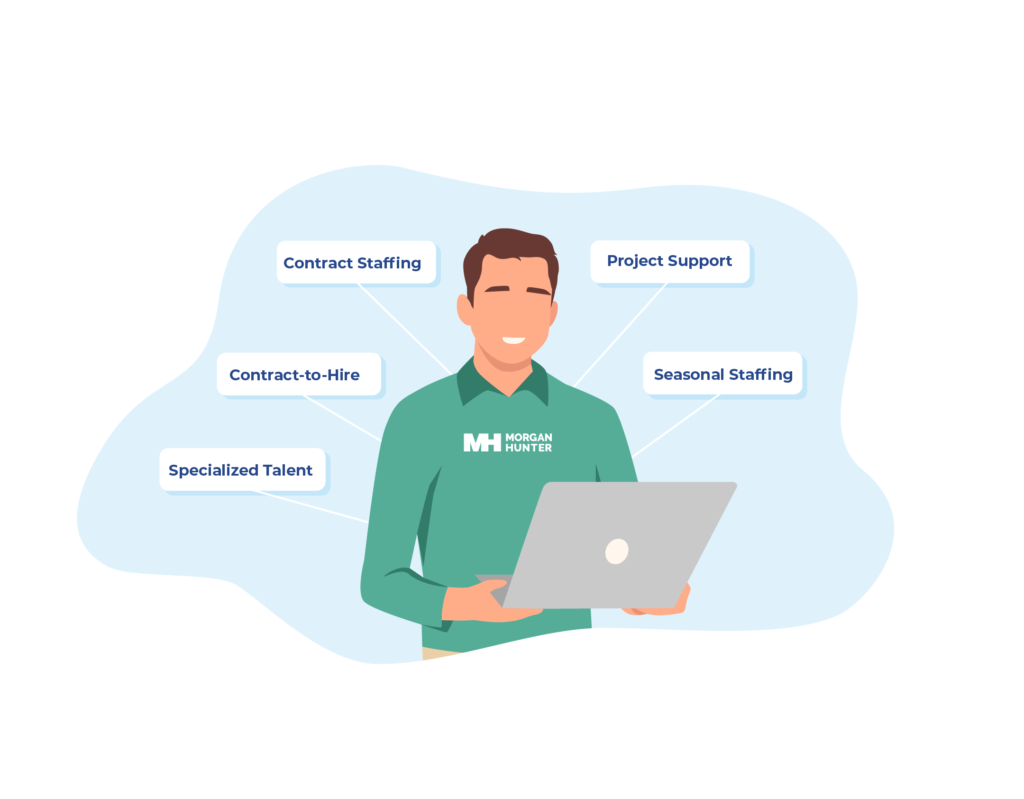
At Morgan Hunter, we work with organizations every day that are navigating changing business conditions while still pushing growth forward. Whether companies need short-term project support, specialized expertise, or contract-to-hire solutions, the right staffing strategy can create momentum when it matters most.
Because sometimes growth is not about building the biggest team as quickly as possible.
Sometimes it is about building the right team at the right time. Contact us to learn more.